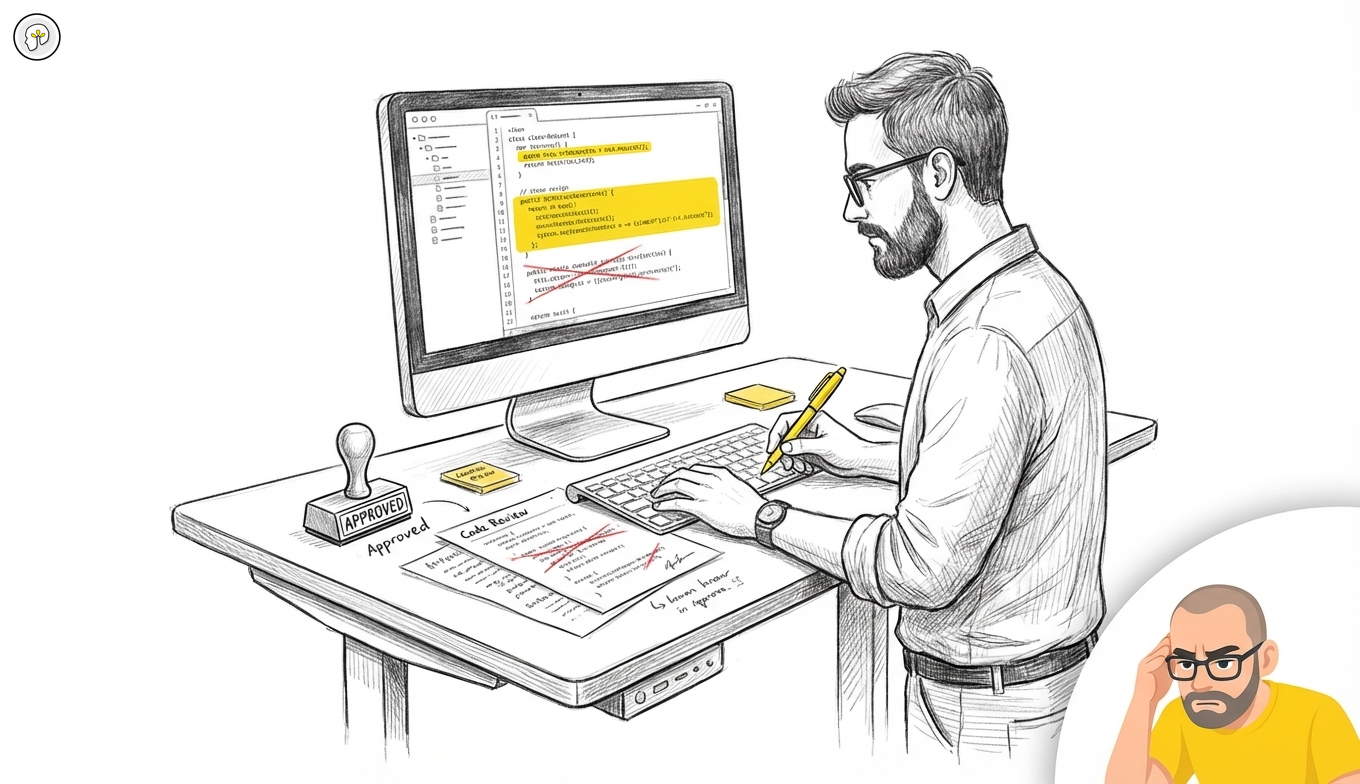
Why developer accountability cannot be automated
Why do some AI implementations succeed while others fail spectacularly? The developer is personally responsible for everything that's output. I see this pattern consistently - beautiful AI-generated code that impresses stakeholders, then catastrophic failures when no one validates what actually got deployed. The difference isn't the AI. It's whether someone takes real responsibility for what comes out.
The responsibility gap I see everywhere
Here's the pattern I keep running into: teams use AI to generate code, then treat it like magic. They deploy without understanding, debug without context, and blame the AI when things break.
But AI doesn't take responsibility. AI doesn't get fired when systems fail. AI doesn't answer to users when data gets corrupted.
You do.
My validation framework from real projects
Real validation requires systematic approaches. Processing 34 database changes from a single meeting requires validating every single one before it touches the database. I use three validation layers that each catch different problems. The technical check asks whether the code actually works and is secure. The business check verifies it solves the right problem and fits constraints. The reality check determines whether real users will actually be able to use this thing. Each layer catches different problems. Skip any layer, and you're gambling with production.
The confidence scoring that saves projects
You should have reasoning and you should have a confidence score. This principle has transformed how I work with AI. Every AI output should tell you what it's proposing, why it thinks this is right, how confident it is (0-100%), what could go wrong, and what alternatives exist.
My decision rules are straightforward. For 90-100% confidence, quick review is usually sufficient. For 70-89% confidence, detailed review is required. For 50-69% confidence, significant changes are needed. Below 50% confidence, I start over with my own thinking.
The hallucination reality
Hallucinations are usually bad prompting, not AI failure. Better prompting helps, but let me be honest: hallucinations still happen regardless. AI can generate code that looks perfect but has subtle bugs, database queries that run but return wrong results, and integration patterns that work in isolation but fail in production.
The scary part? They all look convincing. Only domain expertise catches them. AI cannot tell you when it's wrong - that's fundamentally not how these models work.
My risk-based oversight system
Not everything needs the same level of checking. I match oversight to risk levels. Low risk tasks can be automated with monitoring and include data processing routines, standard reports, and simple calculations. Medium risk tasks require human approval and include database changes, security updates, and user-facing features. High risk tasks should be human-driven with AI help and include architecture decisions, business logic changes, and anything touching money or personal data.
Workflow that doesn't slow you down
The key insight I've found: validation should speed you up, not slow you down. My approach is straightforward. AI suggests, clearly marked with confidence. I decide with full context. Everything gets logged for learning. Quick rollback if something breaks. Metrics track both speed and quality.
When done right, human oversight catches problems early instead of in production. That's faster, not slower.
The real cost-benefit
Yes, validation takes time. But the consequences without it are severe. Production failures that take days to fix. Data corruption that destroys user trust. Security breaches that cost millions. Projects abandoned because they're unreliable.
Validation overhead pays for itself the first time it prevents a major failure.
My practical rules
These are the rules I follow in every project:
- Never deploy AI output without understanding it
- Always have rollback plans
- Log everything for learning
- Match oversight to risk level
- Design validation to speed up, not slow down
The principle is simple: AI suggests, I decide, I take responsibility.
AI can be used for optimization, but human oversight matters because these tools make mistakes - confidently and convincingly. The future isn't AI replacing developers. It's developers getting smarter about using AI responsibly.
Based on 6 months of AI validation successes and failures Published: August 2025