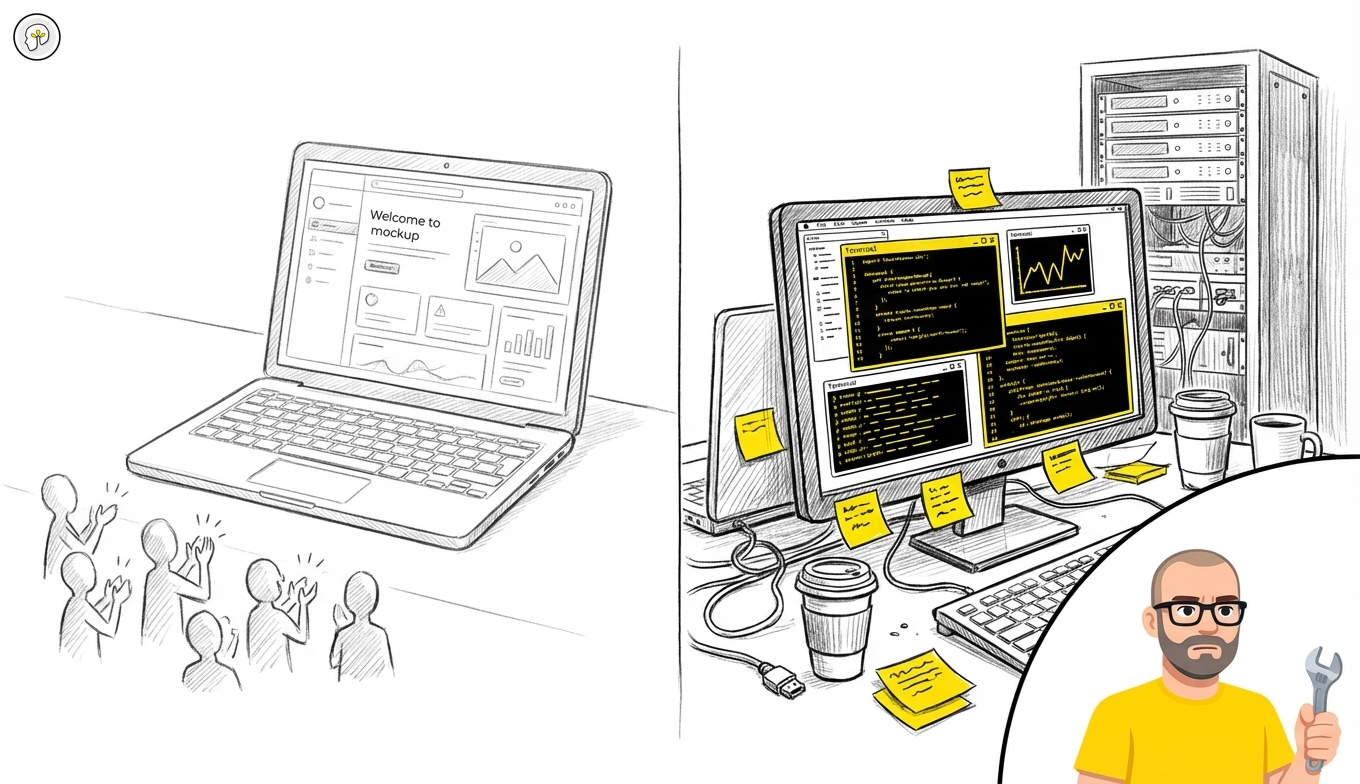
Beyond prototypes: why everyone demos but nobody ships
Why does everyone only talk about prototypes but no one goes to production? The pattern is consistent across development teams, consulting projects, and organizational AI initiatives: beautiful prototypes that wow stakeholders, then months of silence while teams struggle with the 90% of work that actually matters. AI makes it trivially easy to produce something impressive. It cannot substitute for the domain knowledge needed to make it real.
The demo trap I keep seeing
Here's what I keep running into: AI tools make prototypes ridiculously easy. A nice UI in 5 minutes, some AI magic, and suddenly everyone thinks they're done. But that pretty interface? It's maybe 10% of the real work.
The missing 90% is everything that makes software actually usable. Security that doesn't leak data when real users touch it. Error handling for when things inevitably break. Authentication so the right people get in and the wrong people stay out. Monitoring so you actually know when it fails instead of finding out from angry users. Backup systems so you don't lose everything when something goes wrong.
Teams can prototype anything but can't ship anything. They're stuck in demo mode while competitors actually deliver working solutions to real customers.
What I learned building production AI
Production-ready systems require a fundamentally different approach. The difference lies in starting with production requirements that go far beyond just backend code, combined with deep understanding of how infrastructure actually works. You can't build real infrastructure with fancy UI tools - you need to understand servers, databases, networking, deployment pipelines, and monitoring systems. AI helps implement what needs to be done, but someone has to know what needs building.
Cloud infrastructure that scales automatically, but only because I understand load balancing and auto-scaling concepts. Real user authentication that works across devices, because I know how OAuth and session management actually function. Proper database design that handles actual load, because I understand indexing, normalization, and query optimization. Error logging and recovery systems, because I know what failure modes to watch for.
My approach to AI-assisted development requires thinking complete production deployment based on real infrastructure knowledge. Not "how can I make this look cool" but "how will real users access this securely, and what needs to be in place for 24/7 reliability." The AI executes the implementation, but I have to know what needs to be built.
The knowledge problem that breaks everything
Here's what happens constantly: teams use AI tools that generate pretty interfaces, but they don't understand what they're actually building. They click buttons in fancy UI tools and think they're deploying to "production," but they have no idea how the underlying systems actually work.
You can't direct what you don't understand. If you don't know how databases, servers, networking, and deployment actually function, then AI just becomes an expensive way to create sophisticated-looking failures. The fancy UI tools can't teach you what you need to know about load balancing, security models, or failure recovery.
Working with AI for real development requires real knowledge. Complex infrastructure can only be implemented effectively when someone understands what needs to be implemented. This includes knowing what components are required, how they interact, what can go wrong, and how to fix it. The AI executes, but you have to bring the knowledge.
And here's what AI can't do for you: it can't tell you what you don't know. If you lack the experience to recognize a bad architecture decision, AI will happily build that bad architecture for you, fast.
The accountability principle that changes everything
The developer is personally responsible for everything that's output. This cuts through all the hype. Every line of AI-generated code is YOUR responsibility. Every security hole, every failed integration, every broken workflow - that's on you, not the AI.
Once you accept this responsibility, you stop treating AI like magic and start treating it like a powerful tool that amplifies your existing expertise. But if you don't have the expertise to begin with, AI just amplifies your ignorance faster.
Production examples from my projects
The difference between prototype and production thinking becomes clear in real systems:
Project management platform: Prototype = pretty dashboard. Production = voice-to-database integration, user auth, audit trails, real-time sync.
Event registration: Prototype = sign-up form. Production = payment processing, capacity management, refund handling, compliance features.
The prototype gets the meeting, but the production system gets the business.
My production-first rules
These are the non-negotiable principles I follow:
- Start with production requirements - Who are the real users? What happens when it breaks?
- Choose tools for shipping, not demos - Can it handle security? Does it scale? Can you maintain it?
- Validate everything - AI suggests, I verify, I take responsibility
- Plan for failure - Monitoring, logging, recovery from day one
- Ship early, iterate based on real feedback - Not theoretical requirements
The competitive advantage
While everyone else is stuck in prototype mode, production-first teams are shipping. They're getting real user feedback, building trust, solving actual problems.
I've seen companies gain massive advantages simply by being the ones who actually deliver working software instead of impressive demos.
Breaking the cycle
The fix isn't complicated. Celebrate deployments, not demos. Measure success by actual users, not prototype features. Invest in production infrastructure instead of just demo tools. Reward teams for solving real problems, not creating impressive presentations.
There are no shortcuts. You can't shortcut security, reliability, or user experience. But you can use AI to handle the implementation work while keeping production quality - if you know what you're doing.
The question isn't whether you can build an impressive prototype with AI. The question is: can you ship it to production where it actually matters?
Based on 6 months of AI implementation work and real production deployments Published: August 2025