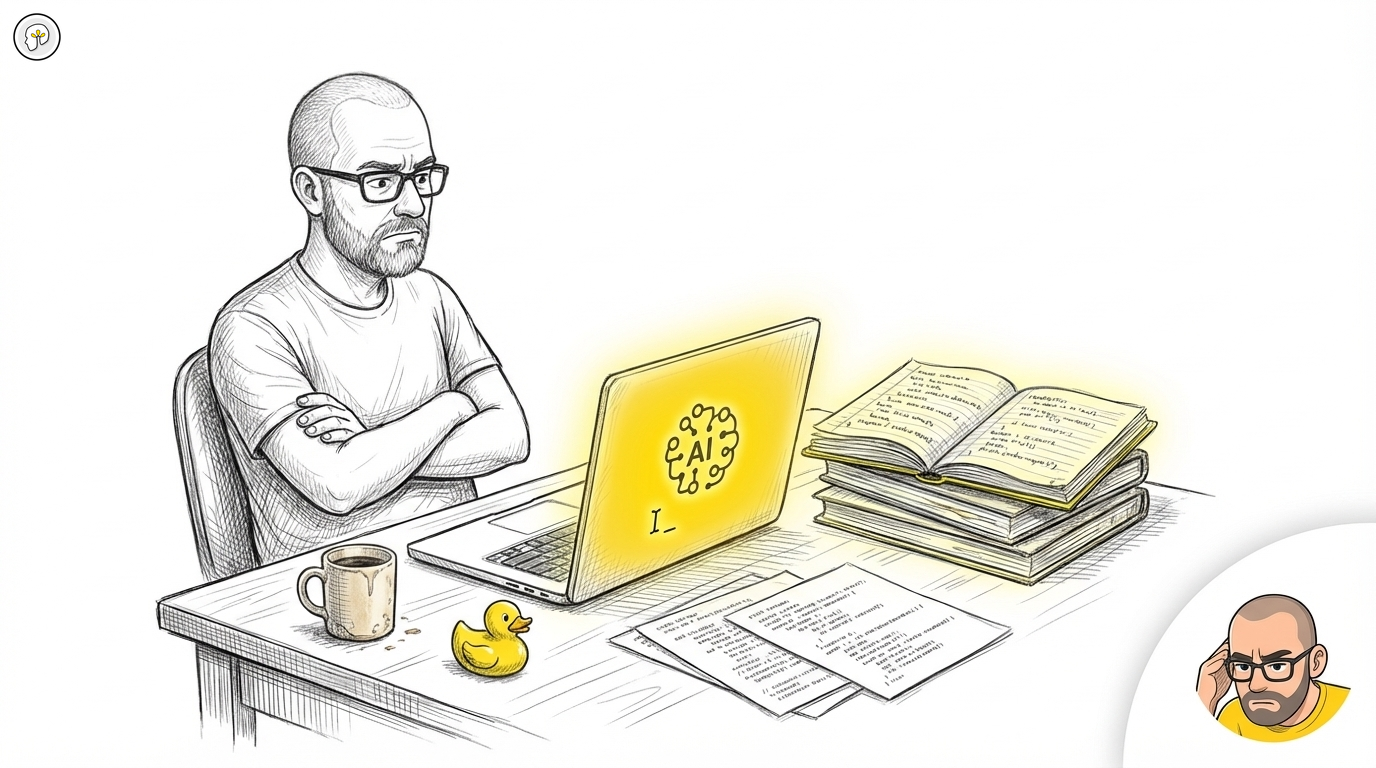
The senior developer paradox: why AI experts resist AI tools
Core Content Fragment
The Expertise Contradiction
One of the most surprising discoveries in AI adoption isn't technical - it's psychological. The developers who are best equipped to use AI tools effectively are often the ones who resist them most strongly. This creates a paradox that's slowing AI adoption across the industry.
"They think it's cheating" - This sentiment from senior developers reveals a fundamental tension between professional identity and technological evolution.
The Validation Capability Gap
Senior developers possess the exact skills needed for AI-Orchestrated coding - the highest paradigm in our framework. They understand the problem space deeply enough to provide full context window alignment and orchestrate AI effectively. They can validate AI-generated code for production readiness, the critical difference between CLI-Coding experiments and AI-Orchestrated systems. They have the expertise required for real-time validation, the key obstacle in AI-Orchestrated development.
As one insight reveals: "When you know the stuff... I couldn't use it to handle COBOL code. I don't know COBOL."
This highlights a crucial truth: AI amplifies existing expertise rather than replacing it. Without the foundational knowledge, even the most sophisticated AI tools become ineffective or dangerous.
The Identity Crisis
Senior developers often see their value in their ability to write elegant, efficient code. When AI can generate functional code quickly, it challenges their sense of professional worth.
Traditional Coding Identity: - Manual code craftsmanship - Deep debugging cycles - Direct problem-solving - Being the technical authority
AI-Orchestrated Reality: - Multi-agent orchestration - Real-time validation during generation - Full context window management - Maintaining production quality through AI
This shift feels like a demotion to many seniors, even though it often requires higher-level thinking.
The "Cheating" Mentality
This perception of AI as cheating stems from several psychological factors:
Effort-Based Value System: Traditional development culture values the struggle, the late nights debugging, the satisfaction of solving complex problems through pure intellect and persistence.
Craftsmanship Pride: Senior developers take pride in their ability to write clean, efficient code from scratch. AI-generated code feels like taking credit for someone else's work.
Imposter Syndrome Amplification: Using AI can make experienced developers feel like frauds, especially when junior colleagues or stakeholders don't understand the expertise required for effective AI orchestration.
Fear of Obsolescence: If AI can write code, what value do senior developers provide? This existential fear drives resistance.
The Junior Developer Contrast
Ironically, junior developers often jump straight to Vibe-Coding approaches, embracing AI enthusiastically but lacking the expertise for proper validation:
"What do we do with the juniors? They're screwed. Because those who don't have the knowledge to see that this is wrong..."
Junior Developer Pattern (Vibe-Coding): - Accept all AI suggestions without review - Minimal understanding of generated code - Work around errors rather than solving them - Create impressive demos that fail in production
Senior Developer Capability (AI-Orchestrated): - Real-time validation during generation - Full context window alignment - Production-grade quality assurance - Understanding every line as it's created
The paradigm gap is enormous - juniors operate in Vibe-Coding while effective AI requires AI-Orchestrated expertise.
The Exception: High-Ambition Learners
"We have two in the team who are evaluating now, who are junior... But it's because they have an ambition level that's higher than average."
This insight reveals that successful AI adoption isn't just about seniority—it's about learning mindset and ambition. Some junior developers succeed with AI because they: - Invest extra effort in understanding fundamentals - Actively seek feedback and validation - Combine AI enthusiasm with rigorous learning - Don't assume AI outputs are always correct
The Resistance Patterns
Senior developer resistance manifests in several ways:
Active Resistance: - Refusing to try AI tools - Criticizing AI outputs without proper evaluation - Blocking team adoption initiatives - Insisting on traditional methods exclusively
Passive Resistance: - Trying AI tools superficially and dismissing them - Using AI for trivial tasks only - Maintaining traditional workflows while others experiment - Expressing skepticism about AI capabilities
Intellectual Resistance: - Focusing on AI limitations rather than capabilities - Demanding perfection from AI while accepting human errors - Overemphasizing edge cases and failure modes - Dismissing productivity gains as "not real development"
The Cost of Resistance
Organizations pay a high price for senior developer resistance:
Productivity Stagnation: Teams without senior AI adoption miss out on 4-5x productivity improvements that proper AI orchestration can provide.
Cultural Division: Resistance creates tension between AI-enthusiastic juniors and skeptical seniors, fragmenting team dynamics.
Competitive Disadvantage: Companies with AI-resistant senior teams fall behind those that successfully bridge the expertise gap.
Innovation Paralysis: Without senior validation, AI experiments remain at the prototype level, never reaching production quality.
Breaking Through the Resistance
Successful AI adoption requires addressing the psychological and cultural barriers:
Reframe the Role: Position AI as a tool that elevates senior developers to higher-level architectural and validation work, rather than replacing their coding skills.
Emphasize Expertise Requirements: Demonstrate that effective AI development requires more expertise, not less. The validation burden actually increases.
Show Real Value: Focus on business outcomes and problem-solving capability rather than just code generation speed.
Address Identity Concerns: Help seniors understand that their experience becomes more valuable in an AI world, not less valuable.
The Evolution Path
For senior developers willing to adapt, the transition follows predictable stages:
Stage 1: Traditional Coding (with AI attempts) - Pasting code snippets into ChatGPT like Google - Getting frustrated when AI lacks context - Concluding "AI doesn't understand code"
Stage 2: CLI-Coding Adoption - Learning proper prompt engineering - Providing better context in requests - Still experiencing "black hole" visibility issues
Stage 3: AI-Orchestrated Learning - Understanding full context window alignment - Real-time validation during generation - Maintaining cognitive sync with AI
Stage 4: AI-Orchestrated Mastery - Multi-agent system orchestration - Production-grade AI development - Teaching orchestration principles to others
The Validation Advantage
The paradox resolves when senior developers realize their expertise becomes more crucial, not less:
"The developer is personally responsible for everything that's output."
This responsibility requires: - Deep understanding of the problem domain - Ability to recognize correct vs incorrect solutions - Knowledge of security and performance implications - Experience with system integration challenges
These are exactly the skills that senior developers have spent years developing.
The Future of Senior Development
The most successful senior developers will be those who: - Embrace AI as an amplifier of their expertise - Develop sophisticated prompt engineering skills - Build effective validation and quality processes - Mentor others on responsible AI development - Focus on architectural and system-level thinking
Conclusion: From Resistance to Leadership
The senior developer paradox isn't permanent. As the industry matures, we're seeing early adopters among senior developers becoming the most effective AI practitioners. Their domain expertise, combined with AI capability, creates unprecedented productivity and quality.
The key insight: "It's still you who builds" - AI doesn't replace the developer's role; it transforms it. Senior developers who understand this become leaders in the AI era, not casualties of it.
The future belongs to those who can combine deep expertise with AI orchestration skills. Senior developers have the expertise - they just need to overcome the psychological barriers to adding AI orchestration to their toolkit.
Development Notes
- Content Type: Psychology / professional development
- Target Audience: Senior developers, technical leaders, engineering managers
- Key Message: Senior developer resistance is psychological, not technical - expertise makes AI more powerful, not obsolete
- Status: Initial draft based on research insights
- Next Steps: Add specific examples from portfolio projects when available
Potential Portfolio Connections
- jsonflow: Senior developer AI adoption journey and validation processes
- record-me: Audio processing expertise combined with AI transcription
- tic: Business intelligence domain knowledge amplifying AI analysis
- sumtastic.app: Content expertise guiding AI aggregation and summarization
- grabb3r: Competitive analysis expertise directing AI data collection
Expansion Areas to Develop
When portfolio projects provide real examples: - Case studies of successful senior developer AI adoption - Before/after productivity comparisons - Specific examples of validation processes that work - Stories of overcoming resistance and identity challenges - Examples of seniors becoming AI orchestration leaders
Key Concepts to Explore
- Expertise Amplification: How domain knowledge makes AI more powerful
- Identity Evolution: Professional identity transformation in AI era
- Validation Requirements: Why senior expertise becomes more important
- Resistance Psychology: Understanding and addressing adoption barriers
- Leadership Opportunity: How seniors can lead AI transformation
Fragment captured: 2025-08-13 Development status: Initial draft - psychological insights established