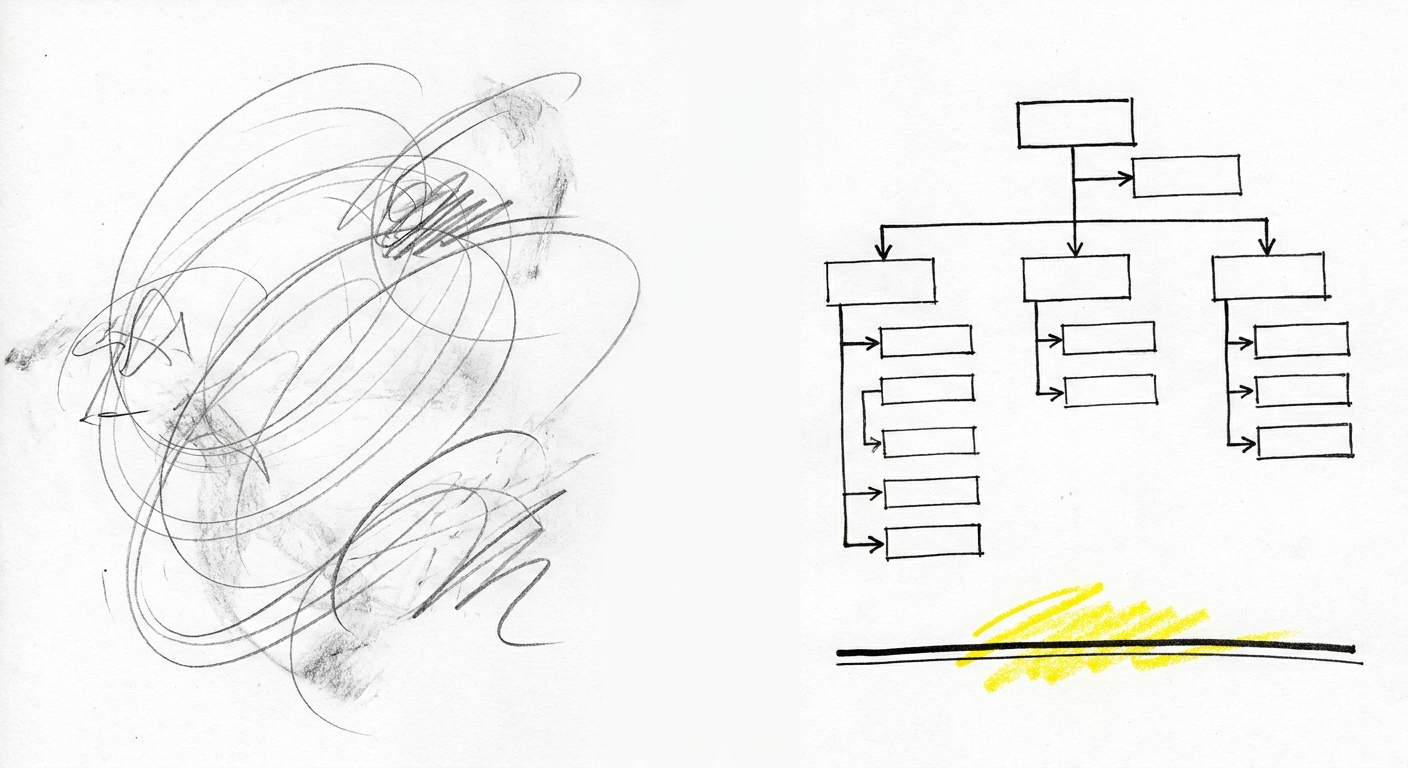
What actually changes when your team uses AI
There is a version of this conversation that leaders hear often. AI is transforming everything. Every role will change. The speed of work will double. What worked before will not work now.
Some of it is true. Most of it is not specific enough to act on.
Here is what actually changes — and what does not.
What does not change
The org chart does not change. Someone is still responsible for the team. Someone still owns the client relationship. Someone still signs off on the deliverable.
The accountability structure does not change. If a project fails, the accountability sits with the people who made the decisions — not with the tool those people used.
The value of domain expertise does not change. A project manager with ten years in infrastructure knows things about how projects fail in that domain that no AI tool has access to. That knowledge is what makes AI output usable. Without it, the output is pattern-matched from training data that does not know your context.
What does change
Where the work happens changes significantly.
A report that took three hours to compile from five data sources now takes twenty minutes. A first draft that required a blank page and two hours now starts from a structured outline. A status update that required switching between four tools now surfaces from a single prompt.
The volume of output increases. The speed of first drafts increases. The time spent on aggregation and formatting decreases.
This is real and it matters. But it is not the same as saying decisions happen faster, or that accountability moves, or that expertise becomes less important. It means the early steps in a workflow change. The steps that require judgment do not.
The gap that matters
Research on AI adoption in professional settings consistently shows the same pattern: adoption rates are high, trust without verification is low. A large majority of people use AI tools. A much smaller number verify the output rigorously before acting on it.
This gap is where risk accumulates. Not because AI is unreliable by nature — it can be highly reliable for specific tasks — but because the output looks finished even when it is not. A well-formatted document with confident language is easy to pass along without reading carefully. That is true of human-written documents too. The difference is that AI can produce them at a volume and speed that outpaces a team's review capacity if no structure is in place.
The three things that do not transfer
There are specific categories of work that AI cannot own — not because of current limitations that will be fixed in the next version, but because of what ownership requires.
Judgment under uncertainty with consequences. When a decision involves trade-offs, incomplete information, and accountability for the outcome — a supplier choice, a personnel decision, a scope change under pressure — a person needs to own it. AI can surface options, summarise context, and flag patterns. The call belongs to someone who can be held responsible for it.
Relationships. A client relationship, a team dynamic, a difficult conversation with a partner — these depend on trust built through interaction over time. AI can draft a communication. It cannot build the relationship the communication exists within.
Accountability. When something goes wrong, who answers? That question always resolves to a person. AI is a tool those people used. The accountability structure stays the same regardless of which tools are in the workflow.
What this means for a leadership team
The practical implication is straightforward: before your team rolls out AI tools broadly, define what always requires human sign-off.
Not everything. Not a bureaucratic checklist for every task. The specific categories where the output has consequences — client deliverables, financial data, compliance documents, decisions that affect people — and where the accountability is clearly owned.
Organisational structure — how accountability is defined, how output is reviewed, who owns which decisions — has roughly twice the impact on AI outcomes as individual attitude or skill level. Enthusiasm without structure produces inconsistent results. Structure without enthusiasm is manageable. Neither is optional.
What comes next
Part 2 covers what your leadership team specifically owns when your team uses AI: the decision line, what review actually means, and what happens when something goes wrong.
Next in this series: Part 2 — What you own when your team uses AI