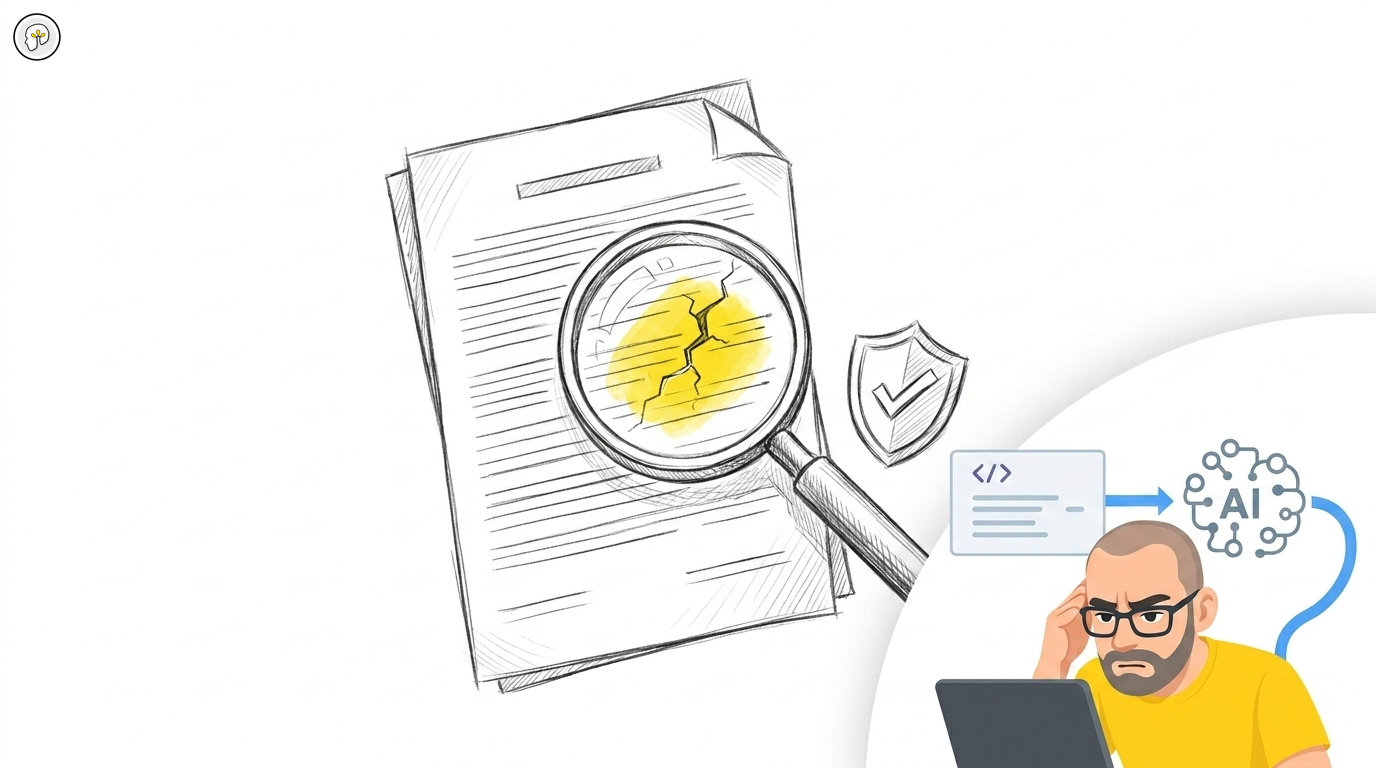
Own it, don't trust it
This is the part that separates a skill you can rely on from one that quietly causes harm — and it is the part the floor-level "just build a skill" advice leaves out.
Here is the uncomfortable truth about a skill: it repeats your process at speed, including its blind spots, with your name on every output. That is the deal. A skill does not add judgment; it scales whatever judgment you put in. So the discipline is not "trust the skill." It is "own the output."
Looks finished is not the same as is right
The most common failure has nothing to do with bad formatting. It is the opposite. A skill produces something polished — three clean paragraphs, the right structure, a confident tone — and it is quietly wrong. It filled a gap with an assumption because the draft "read like" it was complete. It treated a guess as a fact because the guess fit.
That is the trap: polish reads as correctness, and a good skill produces a lot of polish. So you validate the substance, not the surface. Is this actually right — against what you know, and against the sources? A skill that looks finished has earned a closer read, not a faster send.
Check the facts, not just the flow
Be especially ruthless with factual claims a skill produces — numbers, names, dates, data points. This is where a skill does real damage, because a wrong figure in a clean report reaches a stakeholder looking entirely authoritative.
A skill cannot know what it does not know, and it will state a wrong fact as confidently as a right one. So check the claims against their source. Every time, until the workflow has earned a narrower kind of trust — and even then, on the things that matter.
Build the guardrails into the skill
Owning the output does not mean carrying all the vigilance yourself. The best skills carry guardrails of their own. Two patterns worth borrowing, drawn from production skills that run every day:
An explicit "never do this." State the things the skill must not do — the lines it cannot cross, the actions it must never take without asking. A short, standing list of prohibitions catches the failure modes you already know about.
A check it re-runs to confirm its own result. A strong skill does not just produce output; it verifies the output against its own rules and reports what it found — and after a fix, it checks again to confirm the result is clean. A skill that audits its own work is far easier to trust than one that simply hands you something and stops.
Neither of these removes your ownership. They make it sustainable.
A skill is never truly done
Finally: a skill you trust can start producing different results without you changing a thing. An underlying model updates. A source it reads gets restructured. Nothing announces it — the output just drifts.
So treat a skill as a living thing, not a finished artifact. Audit it periodically. When you do change it, remember you are changing every future output, not just one — so change it deliberately, the way you would change anything you own and put your name to.
Where this goes next
That is the floor and the ceiling in one idea. Anyone can build a skill — the community has that covered. Owning it, validating it, building the guardrails in: that is the discipline, and it is what makes a skill safe to rely on in real work.
From here the curriculum climbs. Skills in Production (Track 3) covers chaining skills into pipelines and wiring them to your tools. Skills as Governance (Track 4) covers sharing them across a team safely — versioning, review, and the org-level libraries that turn one person's good skill into the whole team's standard.
This completes Skills Fundamentals. Continue with Skills in Production when you are ready to compose skills into real workflows.