Why Accountability Disappears in Teams — and the One Thing That Prevents It
Organisations that implement AI-assisted development often believe they have accountability because they have processes.
They don't. They have the appearance of accountability.
This distinction matters more now than it did three years ago. AI tools accelerate the production of code that looks right, passes tests, and gets committed before anyone has genuinely understood it. The processes — code review, sprint reviews, QA sign-off — are still there. But the accountability has silently evacuated.
How accountability disappears
The pattern is consistent across organisations. It usually starts small.
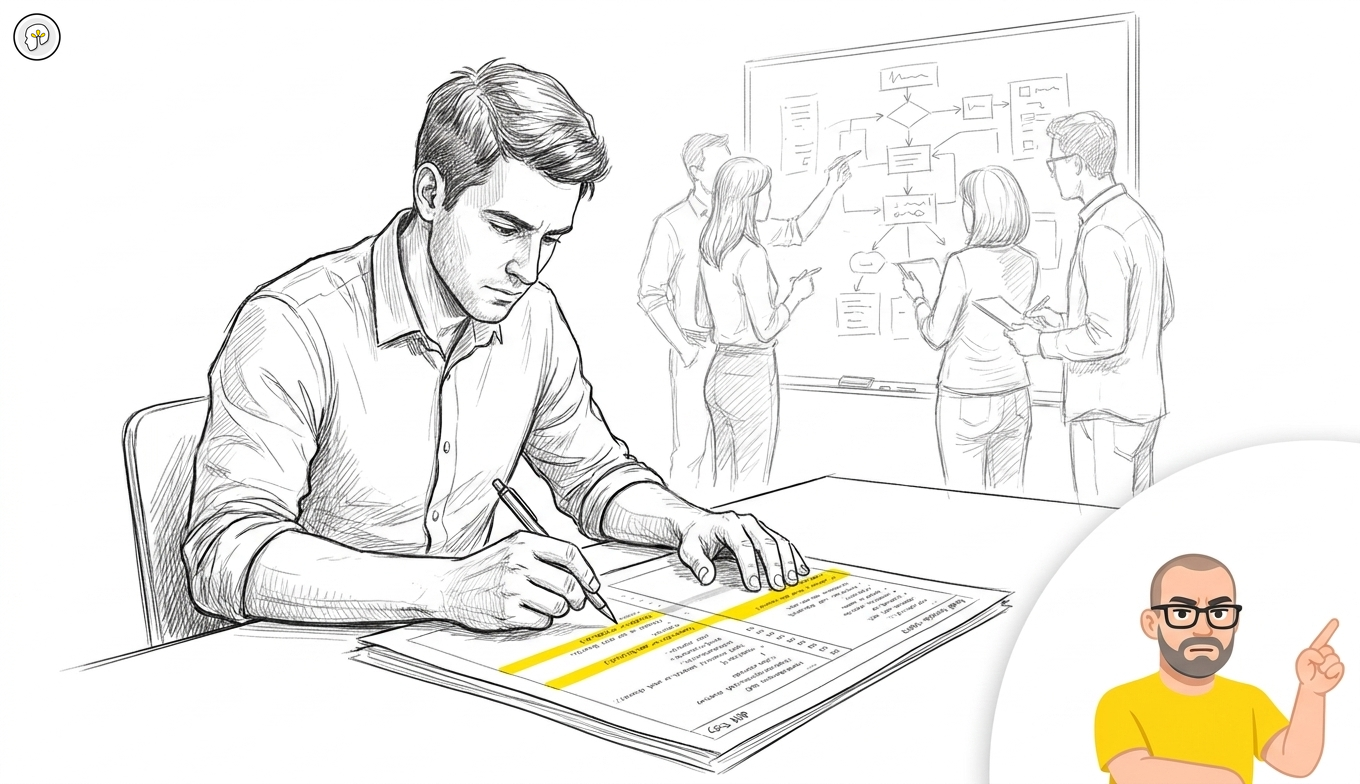
A developer uses an AI tool to build a feature. The output looks clean. The tests pass. The PR gets reviewed — but quickly, because the code looks fine. The reviewer trusts the developer. The developer half-trusted the AI. The result ships to production carrying nobody's actual understanding.
Nobody decided to skip accountability. It just diffused across the chain until nobody held it.
This is what accountability diffusion looks like in practice: every handoff in the process dilutes individual ownership slightly, until the question "who actually understands this line of code?" has no honest answer.
"Everyone reviewed it" means no one reviewed it. The more people nominally responsible for something, the less any one of them actually owns it.
Why AI makes this worse
Manual code has a natural accountability checkpoint: the person who wrote it understands it. They might not have written it well, but they know what it does and why.
AI-generated code breaks that link. A developer can commit fifty lines they didn't write and don't fully understand. The code might be functionally correct. It might pass every test in the suite. And it carries a hidden liability: nobody owns it.
When that code breaks — in production, three months later, under conditions nobody anticipated — the question "who is responsible?" produces only pointing. Not because anyone acted in bad faith, but because accountability was never attached to the code in the first place.
The AI acceleration that makes teams faster also makes accountability diffusion faster. More code, more commits, more surfaces where nobody's understanding was actually tested.
Why personal accountability is the foundation, not a pillar
The Mindtastic framework places personal accountability as the foundation beneath the four pillars — not as one principle among several. This is why.
Accountability cannot be shared. The moment it belongs to multiple people equally, it belongs to none of them fully. This is not a cultural observation — it's a structural one. Distributed accountability is a contradiction in terms. What gets distributed is the appearance of accountability.
Consider the alternative: if personal accountability were a pillar — one principle among four — it could in theory be traded off against the others. Strong context mastery might compensate for weak accountability. Sharper thinking might partially substitute.
It cannot. Accountability is pre-conditional. Without it, the other pillars describe how to work efficiently without anyone responsible for whether the work is correct. That is a faster path to the same failure.
Three levels, three different standards
Not all development contexts carry the same accountability requirement. Understanding the difference is as important as understanding the principle. Each level has a name, a realistic performance ceiling, a natural drift pattern, and a minimum policy requirement.
Level 1 — Solo (>10×): Your risk. Your consequences. If you choose not to review every AI-generated line of a personal project, that's a rational decision. Vibe coding is legitimate here — you feel the consequences immediately. The accountability mechanism is your own judgment, and nothing else is required.
Natural drift: toward vibe coding. Minimum policy: none.
Level 2 — Engagement (5–10×): The client's system. The client's data. Your name on the contract — and on the code. The work loop becomes a professional obligation, not a choice. You must be able to say "I understood every line I committed." Solo habits — "it looks right" instead of reading the diff — are a professional breach at this level.
Natural drift: solo habits. Minimum policy: work loop non-negotiable, every commit requires understanding.
Level 3 — Team delivery (2–5×): Everything from level 2, plus the structural risk that no named person ends up owning anything. This is where individual accountability must be made explicit and enforced by method, because diffusion is the path of least resistance. The 2–5× ceiling is not a failure — it reflects the governance overhead that is appropriate and necessary when consequences land outside the team.
Natural drift: accountability diffusion. Minimum policy: named owner per commit + shared team policy decisions (recording, data, code standards, parallel threads).
Mindtastic's training targets level 3. Not because levels 1 and 2 don't matter, but because level 3 is where accountability most commonly disappears — and where the consequences are carried by someone outside the team.
The pattern is always the same: solo behaviour in a team delivery context. A real example: a team building a new scheduling module during an all-hands AI workshop shipped conflict detection, driver assignment, and an initial mobile app view — all into the production codebase, in a single afternoon, with no change requests, no documentation, and no named owner per commit. When asked "what does your internal policy say about this?" the answer was silence. Not because anyone acted in bad faith. Because the team had never had to decide.
The commit as the only anchor that works
There is one mechanism in software delivery that resists diffusion: the commit.
A commit has a name on it. One developer. That developer, at the moment of committing, either understood every line they were signing — or they didn't. There is no collective commit. There is no "we committed this." There is a named person who made a decision.
This is why step 6 of the work loop — commit and document — is not administrative. It is the accountability step. And it only works if step 5 actually happened: the developer reviewed every line, assessed their confidence, and stopped when they didn't understand something.
High confidence: I understand every line. I can explain why it does what it does. → Commit. Medium confidence: It looks right but I'm unsure about parts. → Review more. Ask the model. Ask a colleague. Low confidence: I don't understand why this works. → STOP. Understand before proceeding.
In a team, this standard must be applied by every developer to every commit. There is no collective bypass. A code reviewer can flag issues, but they cannot transfer ownership. The developer who commits owns it.
What "the company is accountable" actually means
Contracts and SLAs assign accountability to organisations. That's correct and necessary.
But organisational accountability only has operational meaning if it traces back to individual accountability. When something fails in production, "the company is responsible" is a legal statement. The operational question — "who understood this code and signed off on it" — must have a human answer.
If it doesn't, you don't have accountability. You have liability without the internal structure to learn from it, fix it systematically, or prevent it from happening again.
This is the distinction that matters when organisations evaluate whether their AI-assisted development practice is responsible. Not whether they have a process. Whether they have a named human who owns every line that ships.
The process can be lightweight or rigorous. The tools can be old or new. The team can be large or small.
But someone has to own the code. And that someone has to have read it.
The framework this article applies: The Foundation — Four Pillars and the Work Loop · AI Development Accountability Levels · The work loop — six steps · The 90% AI-coded myth