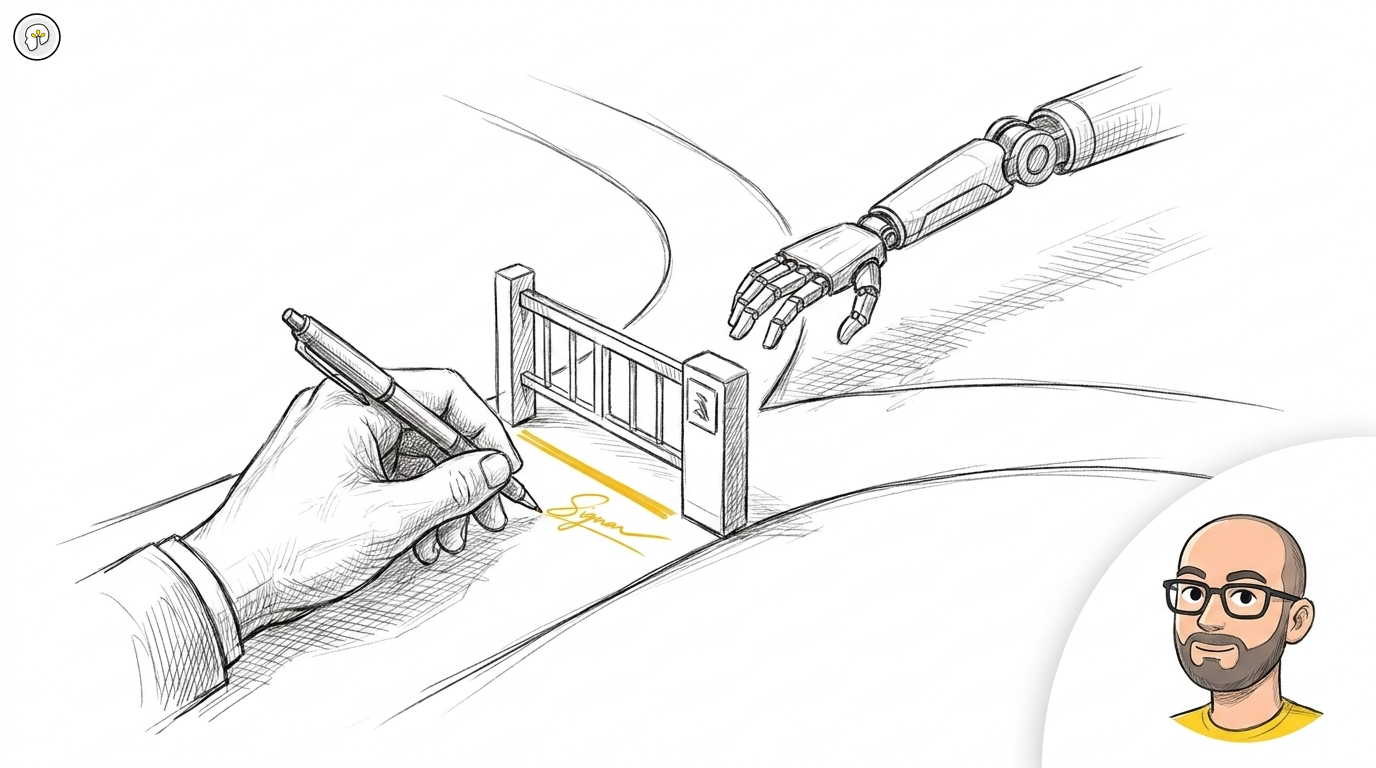
The accountability test
In 1979, IBM put up a slide in an internal training session. Two typewritten lines: a computer can never be held accountable, therefore a computer must never make a management decision. We are going to take it at face value. The paper trail behind the photograph is thin, but the weight is not in who said it. It is in what it says, and what it says is a test every leader deploying AI can run this week.
The slide was a syllogism, not a slogan
Most people quote the sentence and stop. But the page behind it, read through the show-through, defines a management mandate in three parts: authority, responsibility, and the capacity to be held accountable. It then sets a value on each. On the third, applied to a computer, it prints one answer in capitals: none whatsoever.
So the argument is not that computers are unreliable. It is that accountability is a precondition for holding a mandate at all. Something that cannot bear it cannot hold one, however good its judgment. That is not a claim about 1979 hardware. It is a claim about the nature of a decision.
The test itself
Here is the operational version, and it fits on one line. For any decision you are about to hand to an AI, ask: when this goes wrong, who is accountable? Name the person. If the honest answer is no one, you have not automated a decision. You have removed the person who answers for it, and left a gap where the accountability used to be.
That gap is where AI deployments fail in production, not in the demo. The demo works. The gap only shows up the day something goes wrong and everyone looks around the room for who owns it.
Capability is the wrong axis
Leadership teams keep asking the same question: is the model good enough yet? It is the wrong question, because the answer weakens every quarter. Each new model is more capable, so a decision that felt too risky to automate last year feels safe this year, and the line keeps sliding.
The accountability question does not slide. A model that becomes twice as capable does not become half as accountable. It becomes exactly as unaccountable as before. Capability tells you what an AI can do. Accountability tells you what it may decide. Those are different axes, and only one of them moves.
Where the line actually falls
This is the part we train. You do not draw the line once for "AI" in the abstract. You draw it decision by decision.
- Map the decisions the AI touches. Not the tasks, the decisions. A task can be handed over freely. A decision has consequences that land on someone.
- Sort each one. Reversible and low-consequence: let the AI run, sample-check the output, move on. Trust-bearing, meaning money, safety, or a promise to a customer: gate it to a named human before it takes effect.
- Make the gate a real person, senior enough to validate. A gate that rubber-stamps is not a gate. You cannot sign off on what you do not understand, so the person at the gate has to be able to see when the answer is wrong, not just that an answer exists.
- Refuse the black box. If an agent acts and no one owns what it did, that is not efficiency, it is an unclaimed liability. The pattern that works, the one serious operators land on, is simple: the human stays accountable for the agent, always, even when the agent does most of the work.
None of this is a brake on AI. The checkpoint is not friction for its own sake. It is the moment the decision actually gets made, by the one who will answer for it.
The travesties they already named
The same 1979 page listed what it called travesties, confusions to avoid. Two of them read strangely well today: the computer as manager, the computer as god. They did not foresee a model architecture. They foresaw the confusion of swapping the one who bears a decision for the thing that computes it, and they named it a category error rather than an efficiency choice.
That is the confusion the test is built to prevent. Draw the line before you deploy, not after the incident review. Name the human. Then the system has an owner, and the mandate stays where it belongs.
Companion piece (the personal take): En dator kan aldrig ställas till svars. Related: The AI Validation Imperative and Accountability levels.