MCP in enterprise: a workflow that is actually owned
Most teams that start using Claude Code discover the same gap after a few weeks: the code moves, the ticket does not.
A feature is implemented. The branch is ready. The PR is open. But the Jira ticket is still "In Progress" because someone forgot to update it, or the update happened hours later after a context switch. The board does not reflect the actual state of the work.
MCP closes that gap. But only if the workflow is designed deliberately.
The enterprise agentic loop
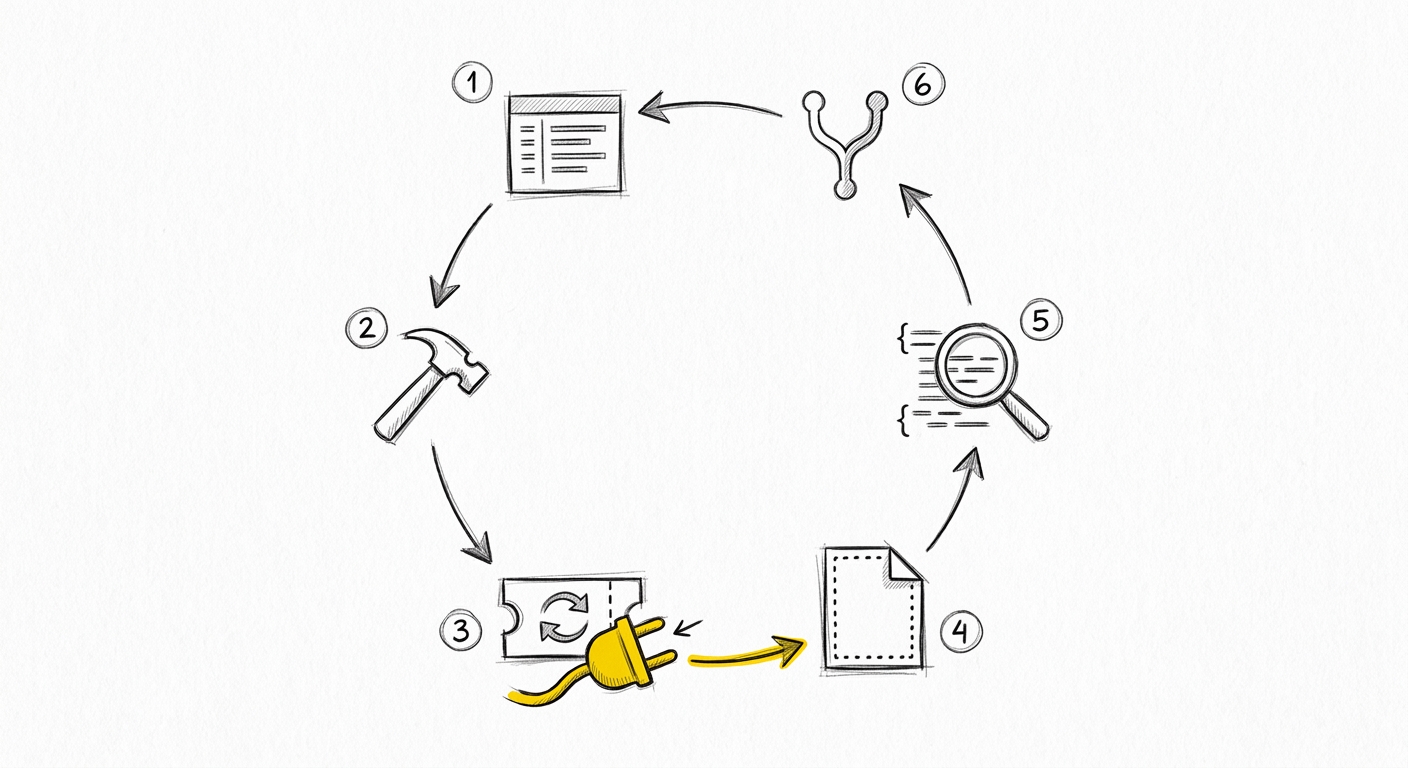
A senior developer working with Claude Code on an enterprise project typically runs a six-step loop:
1. Plan. Plan mode. Claude reads the relevant context — CLAUDE.md, recent commits, the Jira ticket description — and produces a step-by-step implementation plan. The developer reviews and adjusts before anything is built.
2. Build. Claude works on autopilot in a git worktree: a separate working directory isolated from the main branch. The developer watches the progress log. Multiple worktrees allow parallel agents on separate features without file conflicts.
3. Update ticket status. Claude calls the Jira MCP server. It moves the ticket from "In Progress" to "In Review" and posts a brief summary of what was implemented. This happens when the build is complete, before the PR is created. The board reflects the actual state.
4. Create draft PR. Claude creates a draft pull request. Draft status signals that the code is not yet ready for merge — it is ready for review.
5. Review. The developer reads every changed line. Not a summary, not a diff overview — the actual changes. Manual fixes are common before this step is closed. "Sometimes I make manual fixes before the merge. Sometimes not." Both are valid. The review is the control point.
6. Merge. After review passes — the developer's own review, plus a colleague's — the PR merges.
MCP enters at step 3. It is one step in a loop the developer controls, not an autonomous actor.
Why this loop matters
The value of step 3 is not the time saved on the status update. The value is accuracy.
When ticket status reflects code state in real time, the project board is a reliable signal. Standup is faster. Stakeholder questions get accurate answers. Blockers are visible. The overhead of coordination decreases because the data is trustworthy.
When status updates are manual and intermittent, the board is a rough estimate. Everyone knows it. Everyone compensates with meetings, pings, and context switches to find out what is actually happening.
MCP trades a small setup investment for a persistent accuracy improvement.
Running parallel agents with Jira MCP
Git worktrees enable parallel agent execution: two or three features being built simultaneously in separate directories, each by its own Claude instance.
Jira MCP pairs naturally with this pattern. Each worktree corresponds to a separate ticket. When agent A finishes feature A, it updates ticket A. When agent B finishes feature B, it updates ticket B. The operations are independent. The board reflects both in real time.
This scales in a way manual updates do not. The developer directing two or three parallel agents cannot reliably track the status of each one and update tickets manually without introducing delays. MCP removes that bottleneck without removing the developer from the loop.
Security decisions
An enterprise MCP setup requires three security decisions made explicitly, not by default.
Credential scope. The Jira MCP server runs under credentials you provision. Those credentials should be scoped to the specific project boards relevant to the team's work. Not org-wide. Not admin-level. A service account with read/write on tickets in two specific projects is a reasonable starting point for most teams.
Operation boundaries. Decide in advance which operations Claude can perform without explicit approval and which require a pause. Reading ticket content and updating status to "In Review" are low-consequence operations. Closing tickets, creating new epics, or moving items to Done might warrant explicit approval. Define the boundary before the workflow runs, not after the first unexpected update.
Credential ownership. Someone is responsible for rotating the API token when a team member leaves or a credential is exposed. That person is named before the MCP server goes live. A credential with no owner is a credential that will eventually be a problem.
When not to use MCP
MCP adds complexity. It adds a new process to manage, credentials to rotate, and a new failure mode: "Claude tried to update the ticket but the MCP server was misconfigured."
It is not the right answer for every workflow.
If your team manually updates one ticket per day and it takes two minutes, the MCP setup overhead is not worth it. If your workflow involves sensitive production systems where any automated write operation requires an approval chain, MCP in its basic form is not the right architecture.
Add MCP when the gap it closes is real, repeated, and worth the setup cost. Do not add it because the workflow looks more sophisticated with it. That is the same error the vibe-coding mindset makes in the other direction: complexity added for its own sake rather than for the problem it solves.
Connection to the Mindtastic framework
This loop is Pillars 1 through 4 operating in sequence.
Pillar 1: The developer brings judgment that Claude cannot simulate — reading the implementation plan critically, making manual fixes after review, deciding when the loop is done.
Pillar 2: The model's reach is bounded by what the MCP server exposes. Claude cannot access tickets outside the configured project scope, cannot modify settings it has no credentials for.
Pillar 3: Jira MCP is context in real time. Claude does not need to ask "what is the current ticket status?" because it can read it. That is context mastery, not a better prompt.
Pillar 4: The developer's expertise makes the workflow precise. A junior developer giving Claude vague Jira instructions gets vague ticket updates. A developer with domain knowledge gives Claude instructions that produce accurate, useful output.
The loop is owned because each step has an accountable person. MCP is one step. The developer is the rest.
This is the final guide in the MCP Fundamentals series.
Related: What is MCP (Part 1) and Connect Claude to your tools with MCP (Part 2)