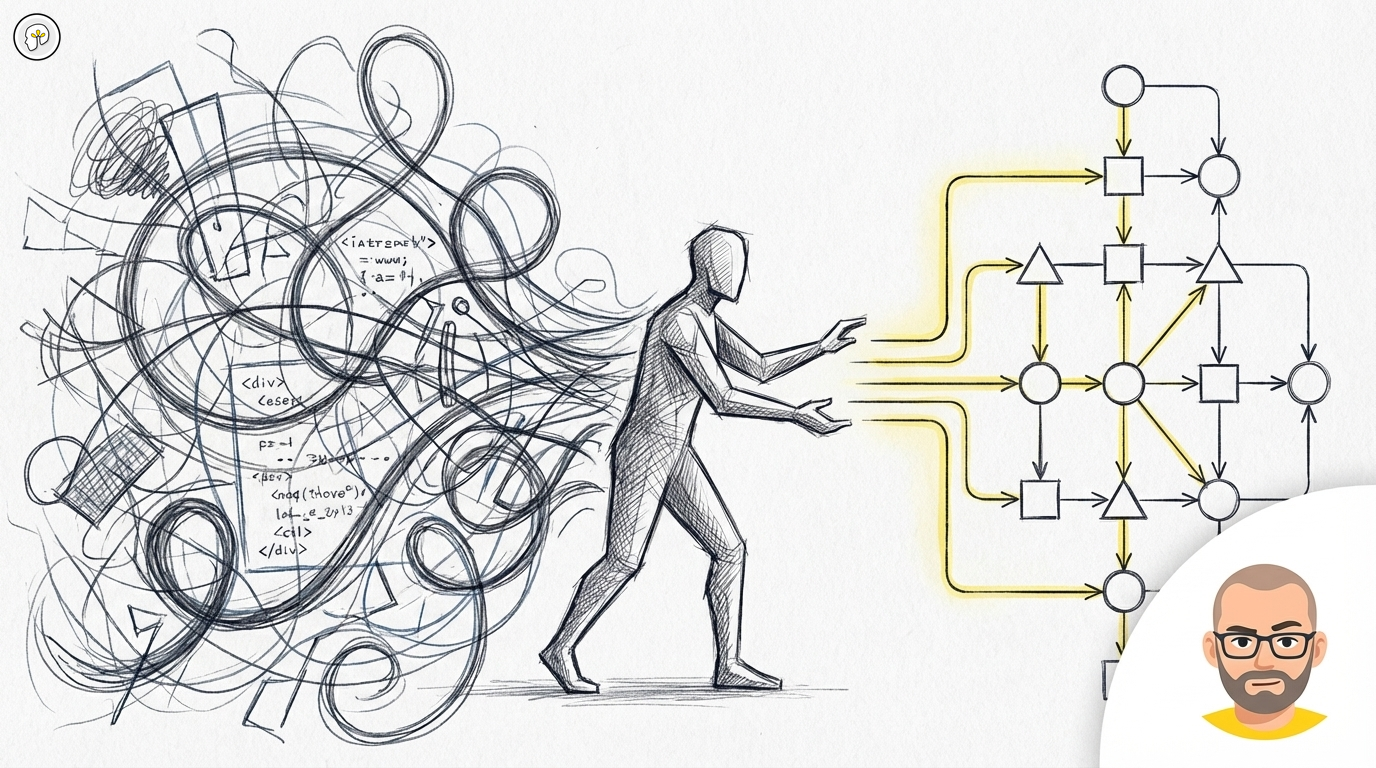
The senior developer trap: When 'AI babysitting' reveals organizational failure
TechCrunch recently claimed "vibe coding has turned senior devs into AI babysitters, but they say it's worth it." This dangerous narrative fundamentally misunderstands AI development. When senior developers spend days fixing AI-generated messes, it's not because AI requires it - it's because organizations chose the wrong development paradigm.
The symptom masquerading as solution
Senior developers report spending most time checking faulty AI code, closing security gaps, and rebuilding AI-generated outputs. TechCrunch frames this as normal, even "worth it" for productivity gains. This misunderstands reality.
When seniors become full-time fixers, organizations aren't implementing AI development - they're implementing broken processes. Andrej Karpathy coined "vibe coding" for accepting AI suggestions without review, explicitly for throwaway projects only. Yet organizations allow this in production pipelines, then wonder why seniors spend all time on cleanup. The problem isn't AI - it's absent methodology.
Wrong context
Senior developers trapped in babysitting roles are victims of organizational immaturity. They're janitors cleaning after uncontrolled AI experimentation, not orchestrators of AI-powered development.
Junior developers or non-technical staff generate code without understanding, accept suggestions blindly, work around errors. Eventually the mess escalates to seniors who must reverse-engineer chaos, identify vulnerabilities, fix architecture, rebuild everything. This isn't AI-assisted development - it's bad process hidden behind buzzwords.
The context window blindness
The most damaging misunderstanding is how senior developers approach AI. They paste isolated code snippets into ChatGPT like it's Google, expecting magical solutions. When AI fails to understand their partial codebase context, they conclude "AI doesn't know" and dismiss the technology. This reveals a critical knowledge gap - not about programming, but about how LLMs fundamentally work.
AI doesn't magically solve problems. It requires orchestration - the developer tells, the AI does. Success demands full alignment with the context window. When seniors paste a single function from a thousand-file codebase, they're guaranteeing failure. The AI lacks the surrounding context, dependencies, architectural decisions, and business logic that make that code meaningful. This isn't AI's limitation - it's the developer's failure to understand how to work with LLMs.
The orchestration principle is vital: AI amplifies what you direct it to do, with the context you provide. Senior developers who understand this maintain full context window alignment, providing complete information about the system, dependencies, and objectives. Those who don't understand this treat AI like a search engine, get poor results, and blame the technology rather than their approach.
What senior developers should actually be doing
The proper role of senior developers in AI-assisted development looks nothing like cleanup babysitting - but it does require intense real-time oversight. There's a critical distinction between two types of "babysitting" that organizations must understand. The wrong kind involves cleaning up AI-generated messes after they've been created. The essential kind involves actively monitoring AI suggestions as they're being generated, understanding each line of code in real-time, staying aligned with the context window throughout the creation process.
When using AI orchestration tools like Cline or RooCode, developers must "babysit" the screen during creation - not as passive observers but as active participants who understand every suggestion before it becomes part of the codebase. This real-time oversight is crucial because it maintains cognitive alignment between the developer and the AI's context window. Without this alignment, developers cannot take full responsibility for the output, and the code becomes a black box that nobody truly understands.
In organizations that understand AI development paradigms, senior developers orchestrate AI tools to achieve complex objectives while maintaining production quality from the start. They design systems where AI agents handle routine tasks under proper supervision, establish validation frameworks that prevent bad code from entering the pipeline, and mentor teams on professional AI development practices. The key is that validation happens during creation, not after.
In CLI-coding paradigms, senior developers define the patterns and standards that guide AI assistance. They review AI suggestions not as damage control but as part of a structured workflow where quality is maintained throughout. In AI-orchestrated paradigms, they design multi-agent systems where validation and quality assurance are built into the process, with developers staying mentally synchronized with the AI's operations.
The difference is profound. Instead of spending 80% of their time fixing problems created by others, senior developers in properly structured organizations spend their time orchestrating AI while maintaining full awareness and control. They watch every suggestion, understand every change, and remain aligned with the context window throughout the development process. This real-time oversight isn't a burden - it's the essential practice that enables responsible AI-assisted development.
Organizational maturity test
How organizations handle AI reveals technical maturity. Mature organizations implement clear paradigms, validation processes, and accountability. Immature organizations grab AI tools without methodology, create chaos, wonder why seniors are overwhelmed.
The "babysitting" pattern is a failure signal. Organizations skipped essential AI adoption steps - processes, standards, training. They confused experimentation with implementation. Senior developers cost hundreds per hour. Having them fix preventable problems wastes massive resources. Organizations pay premium prices for junior output with senior cleanup - the most inefficient pattern possible.
Real costs
Costs extend beyond wasted salaries. Senior developers burn out from repetitive cleanup instead of challenging problems. They leave for organizations using skills properly. Organizations lose productivity, institutional knowledge, technical leadership.
Without seniors designing proper systems, juniors never learn correct AI practices. They continue generating messes, assuming "seniors will fix it." Organizations develop irresponsibility cultures where nobody owns quality.
Competitive disadvantage compounds. While proper organizations accelerate through professional AI orchestration, babysitting organizations move slower despite same tools. They ship lower quality later, accumulate technical debt, face complete rewrites when chaos becomes unmanageable.
Breaking free
Organizations escape by recognizing senior cleanup isn't normal - it's process failure. Implement proper paradigms, not uncontrolled experimentation.
Teams must understand vibe coding (unacceptable beyond experiments) versus professional AI development (required for production). They need validation training, accountability frameworks, quality standards. AI doesn't eliminate engineering discipline - it amplifies importance.
Restructure AI integration. Instead of anyone generating code then passing to seniors, establish structured frameworks. Seniors define frameworks, not cleanup absence. Juniors learn validation as growth, not pass unchecked code upstream.
Path forward
The solution isn't accepting seniors as babysitters - it's eliminating need for babysitting. Professional AI development means everyone understands code quality responsibility. AI tools operate within defined paradigms, not uncontrolled experiments. Seniors return to proper roles as technical leaders, not cleanup crew.
If seniors spend most time fixing AI-generated code, the organization failed at AI adoption. This isn't progress - it's emergency.
Proper AI development delivers what babysitting promises but fails achieving. Teams move faster without cleanup. Quality improves when validation happens throughout, not as damage control. Seniors contribute more value designing systems than fixing messes.
Organizations can waste senior talent on babysitting while calling it progress, or implement professional practices delivering value. First path: burnout, technical debt, competitive disadvantage. Second path: sustainable acceleration, quality improvement, innovation. The question is organizational maturity to recognize which path they're on.