
One foundation, four pillars
Every method we teach traces back to a single point of origin: personal accountability. Not as a motivational slogan — as a structural requirement. When you accept that you own the output, everything else becomes possible. The anti-shortcuts stance, the discipline around testing, the refusal to vibe-code your way to production. All of it flows from one decision: I own this.
The four pillars that follow are not independent best practices. They are consequences. Accept the foundation and the pillars make sense. Skip the foundation and the pillars look like overhead.
The foundation: personal accountability
You own every line of code. Not the LLM. Not the tool. Not the vendor who promises that their model will handle it. You.
This is not a philosophical position — it is a practical one. When something breaks in production, the person who committed the code is responsible. The LLM does not have a pager. It does not get called at 2am. It does not carry the consequences of a bad deploy. You do.
That asymmetry matters. Consequences create judgment that a language model cannot simulate. The developer who has shipped and broken and fixed things in production knows something that no training data can teach: what it feels like to own the outcome. That experience is what makes LLM-assisted development work. It is also what makes vibe coding dangerous — you are borrowing the output of a system that bears no consequences, and passing it off as your own.
A note on terminology. What the industry calls "AI" in a development context is a large language model — a text predictor of extraordinary capability. It completes patterns from what you give it. It does not understand, reason, or decide independently. Calling it "AI" creates expectations it cannot meet. Knowing it is an LLM tells you exactly how to use it: what you put in determines what you get back. Why the LLM/AI distinction matters in practice →
Accept accountability fully and the question "did I understand this code before committing it?" stops being optional.
Language reveals accountability. "I used Claude to build this" frames AI correctly — as a tool, like a compiler or a debugger. "Claude and I built this" or "Claude did the analysis" frames AI as an agent with independent responsibility. The distinction matters operationally. When something breaks, the question is: who understands it well enough to fix it? AI does not attend retrospectives. It does not carry the context of why a decision was made. If the person who committed the code can only say "the AI wrote it, I'm not sure why it works," the accountability chain is broken — the incident gets acknowledged, but no human takes ownership of preventing it from happening again.
The 90% AI-coded myth · Why developer accountability cannot be automated · The no shortcuts principle
Pillar 1: Sharper thinking
The LLM handles the mechanical work. Everything that matters is still yours.
The common assumption is that a language model reduces cognitive load. In practice, it transforms cognitive load. The work that used to require typing — boilerplate, lookups, syntactic patterns — is now handled by the LLM. The work that remains is the harder kind: defining what should be built, validating that what was built is correct, and deciding what the system should do next.
You stop writing code and start directing it. That requires sharper thinking, not softer thinking. You need to be able to read LLM output critically, catch subtle errors that look plausible, and hold the full system model in your head while the model handles the details.
An LLM is a text predictor — it generates the most probable continuation of what you gave it. It does not flag when its output is wrong. It does not hesitate when it is guessing. The confidence is uniform regardless of accuracy. The quality gate is you. Senior developers recognize wrong answers because they know the domain. That judgment is not in the model.
The failure mode this pillar is designed to prevent is the proxy pattern: the developer relays problems to the LLM and relays answers back, rather than reasoning about the system. It looks like productivity. It is the absence of engineering judgment. Over time, the developer becomes someone who can operate LLM tools but cannot explain the systems they are building — which means they cannot debug them under pressure, cannot extend them safely, and cannot take genuine responsibility for them.
Socratic questions: the 2,400-year-old AI development method · The senior developer paradox
Pillar 2: The limitation
The model solves what you ask. It does not know what you forgot to ask.
An LLM processes what is in the context window — nothing more. This is not a complaint; it is the operating model. The implication is that the model cannot surface what you did not know to include. It cannot question your framing. It cannot notice the constraint you never mentioned.
The rounding error that charges customers three cents too much on every invoice, every month, for three years: no model finds it unless you know it exists. The model implements the rounding function you described, passes all the tests you wrote, and ships to production. The component is correct as specified. The specification was incomplete. That gap lives entirely on the human side.
What you do not know to ask is what gets you. This is not a flaw in the model. It is how language models work — and it is precisely why the model cannot replace domain expertise. A developer who has lived through the consequences of a billing error for three years knows which questions to ask before the function is written. That knowledge does not exist in training data. It accumulates through ownership, failure, and consequence.
Understanding this limitation is what makes context architecture (pillar 3) necessary and domain knowledge (pillar 4) decisive. The path from "fast LLM output" to "correct production behavior" runs entirely through what the developer brings to the context before the first prompt is written.
Beyond prototypes: why everyone demos but nobody ships · The AI pricing trap
Pillar 3: Context mastery
Context first. Prompt second.
Everyone talks about prompt engineering. Fewer people talk about context architecture — what you actually load into the context window before you write the prompt.
The process most people assume: write a good prompt → get good output. The actual process: load the right context → write any reasonable prompt → get good output. The context step is where quality is determined. The prompt is almost secondary.
A developer who loads the relevant files, the error log, the spec, and the architectural constraints before asking a question will get dramatically better results than one who just describes what they want in the most carefully worded prompt possible. Your context window is your workspace. What you fill it with determines what you get back.
This is why experience compounds. A developer with fifteen years on the same platform carries a mental model that no prompt can replace. When they load that model into the context — as specifications, as examples, as constraints, as explicit warnings — an LLM becomes genuinely powerful. Context mastery is not a prompt trick. It is the result of knowing your domain deeply enough to know what the model needs to do its job.
The context window myth: why 1 million tokens is mostly marketing · How Claude Code actually works · The AI rules framework
Pillar 4: Knowledge amplified
Senior × LLM = extraordinary. Junior × LLM = faster mistakes.
This is not a prediction. It is an observation from repeated implementations across organizations. An LLM amplifies what you bring to it. Domain knowledge, architectural judgment, production intuition, pattern recognition from years of debugging — all of it becomes more valuable when the model handles the mechanical work. The cognitive bandwidth freed goes directly into higher-level thinking, and the quality of that thinking determines the quality of the output.
A developer with deep domain knowledge can ask Socratic questions — not because the LLM is smarter, but because they know what wrong answers look like. Without that knowledge, every plausible-sounding output gets accepted. The LLM generates with the same confidence regardless of whether it is right. The expert catches the errors. The non-expert ships them.
The gap between experienced and inexperienced developers widens with LLM tools. This is uncomfortable for organizations that hoped AI would be a great equalizer. It is also true. The correct response is not to pretend otherwise — it is to invest in the training that builds the foundation capable of directing a language model well.
The gap is invisible from the outside. When an experienced developer produces a working system quickly using an LLM, what looks like the model doing the work is actually decades of domain knowledge shaping every prompt, validating every output, and making hundreds of silent architectural decisions along the way. Strip out that invisible context — the judgment about what to build, what to skip, what to test first, what to never compromise on — and the same model produces something that looks similar and breaks differently. The tool is the same. The multiplier is not.
The senior developer paradox · How to build AI systems that actually collaborate · The production reality gap
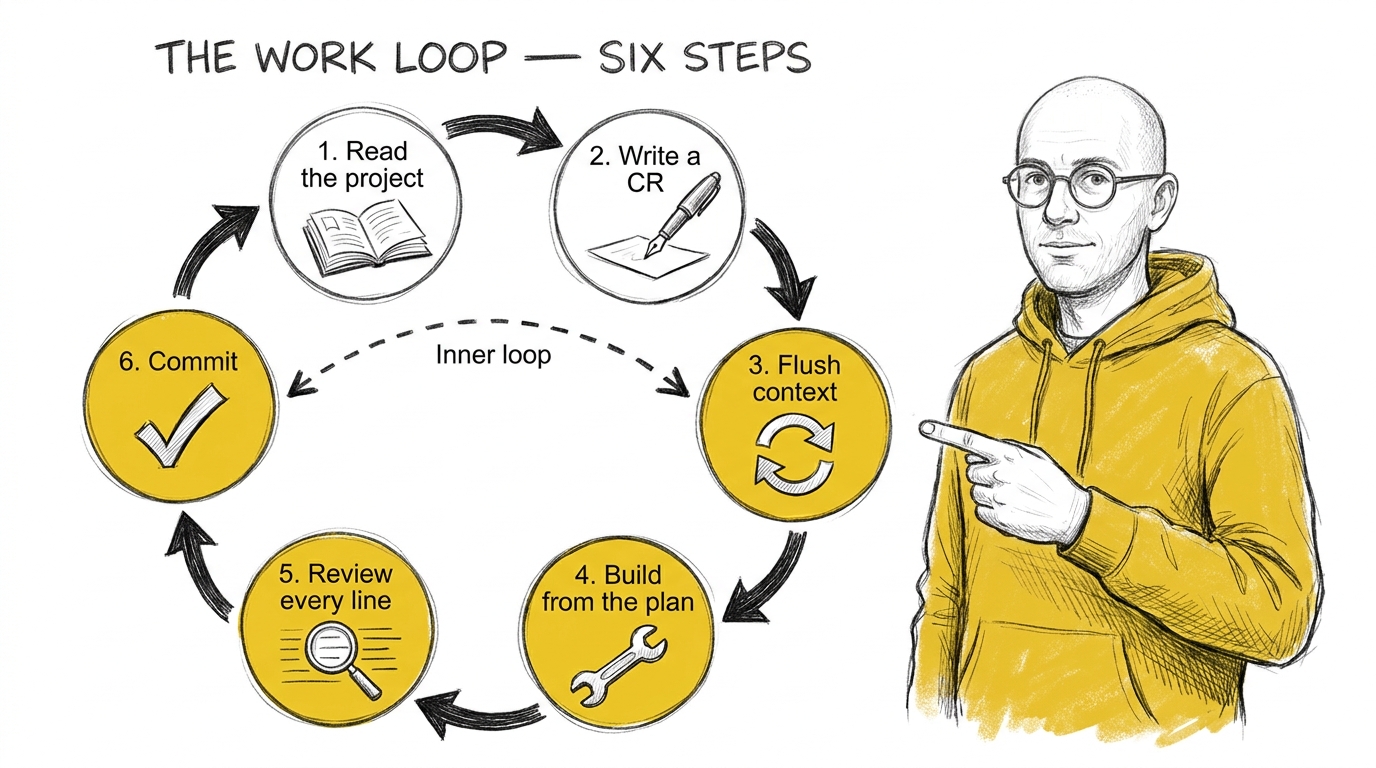
The work loop — six steps that make accountability concrete
Accepting accountability is a decision. The work loop is what that decision looks like in practice.
The problem it solves is structural. An LLM conversation accumulates context: planning discussion, exploratory questions, discarded directions, clarifications. By the time implementation begins, the context window carries the full weight of everything that came before it — including the reasoning that was useful and the noise that was not. The model does not distinguish between them. The developer who codes in the same conversation where they planned inherits that pollution on every subsequent prompt.
The loop separates the phases. Planning produces a document. The conversation closes. Implementation starts from a clean context, with only the plan and the relevant code. The result is more consistent output, fewer accumulated assumptions, and a clear record of what was decided and why.
Step 1: Read the project
Before writing a prompt, load the codebase. Read the relevant files, the git history, the existing conventions, the guidelines, any documentation that bears on the task. Five minutes of deliberate context loading saves hours of incorrect output that needs to be walked back.
The developer who starts by reading understands what already exists and where the task fits. The developer who skips this step asks the model to work without the context it needs — and then wonders why the output does not match the system.
This step also surfaces constraints that would not otherwise be known to include. The billing logic from two years ago. The exception that was added after the incident. The naming convention that exists for a reason nobody remembers but that everything depends on. The code holds that knowledge. Reading it is the only way to bring it forward.
Step 2: Write a change request
Before opening a conversation with the model, write the task down — in a file on disk, not in the chat. Describe what needs to change, why it needs to change, and what done looks like. This is the change request (CR).
The file survives the conversation. When the context is flushed in step 3, the CR carries the plan forward. The chat does not.
For a large task, break it into phases. Each phase gets its own file: its own scope, its own acceptance criteria, its own definition of done. Each phase can then be implemented in a clean context window without the complexity of the full task collapsing into a single session.
The act of writing the CR is itself clarifying. Vague tasks produce vague output. A task that cannot be described clearly in a file is not ready to implement. Writing the CR is not overhead — it is the moment where thinking becomes concrete enough to act on.
Step 3: Flush the context
Close the conversation. Start a new one.
Most developers skip this step. The planning discussion stays open, the implementation begins in the same thread, and the model works with a context that contains everything from the exploratory phase — including the options that were rejected and the directions that were abandoned. That history is noise. It shapes the output in ways that are invisible and unpredictable.
The CR goes into the new conversation. The relevant code goes in. Nothing else from the planning discussion follows. This is the clean context the model needs to implement the plan as written, not as modified by everything that happened before it.
The discomfort of closing the conversation is worth it. The output quality difference is consistent and material.
Step 4: Build from the plan
Follow the change request. The CR is the specification — implement against it.
When the implementation surfaces something unexpected — a constraint that was not known at planning time, a dependency that changes the approach, an edge case that requires a different design — stop. Update the CR first. Document what changed and why. Then implement the updated plan.
This preserves the record. The CR becomes an audit trail: what was planned, what was discovered, what changed, and why. That record is what makes the review in step 5 possible, and what makes the commit in step 6 honest.
Improvising in implementation without updating the plan produces output that cannot be reviewed against any specification. The developer who commits that output owns something they cannot fully account for.
Step 5: Review every line
Read the diff. Every line. Assess each change with one of three confidence levels:
High: The change is understood completely. The developer can explain what it does, why it does it that way, and what would break if it were different. This is the standard for committing.
Medium: The change looks right but some parts are uncertain. More review is needed — read the relevant code paths, test the edge cases, understand the dependency. Do not commit until this becomes High.
Low: The change produces the observed behavior but the developer does not know why. This is a stop signal. Do not commit. Understand what the model produced before it goes anywhere near production.
This step is not a formality before the commit. It is the work. The earlier steps create the conditions for this step to be possible — clean context, a documented plan, a diff that can be reviewed against a specification. Step 5 is where accountability becomes action: the developer either understands what they are committing or they do not, and the confidence level makes that explicit.
Step 6: Commit and document
Write the commit message manually. Describe what changed and why — not just what the diff shows, but the reasoning that produced it. Update the changelog.
The commit is the final accountability checkpoint. It is the moment where the developer puts their name on what they have reviewed and understood. A commit message that was generated by the model is not a record of understanding — it is the absence of one.
If the task has more phases, return to step 3. Start a new conversation. Load the next CR. Keep the contexts clean.
The inner loop
For tasks broken into phases, steps 3 through 6 repeat for each phase. Each phase gets a clean context window: only the phase CR and the relevant code, nothing carried forward from previous phases except the committed changes already in the codebase.
This is what keeps complex tasks manageable. A large refactor implemented in one long conversation accumulates context until the model is working with a distorted picture of the codebase. The same refactor implemented in five phases, each with a clean start, produces consistent output across all five because each phase begins with exactly what is needed and nothing else.
The loop is not a ceremony. It is the structural response to how language models actually work: bounded context windows, pattern completion from what is present, no memory of what was discussed before. Work with those properties, and the model performs well. Work against them, and the accumulated noise becomes the dominant input.
Where the loop sits
The loop is a session. A delivery is not — it runs from the first conversation about what to build through to what reaches production, and no single context window spans it.
These are two altitudes, and the relationship between them is specific: every stage of a delivery is executed by running this loop. Requirements work runs it. Planning runs it. Building runs it once per change request. The loop is not a phase of delivery; it is how each phase is carried out.
Two habits
Not steps in the loop — these apply at all times.
Speak the problem
Voice input gives more context than text. Two minutes spoken beats ten minutes written.
Use it when stuck, when describing a complex situation, or when trying to fill the context window with enough information for the model to reason well. The mechanism is simple: speaking forces narration of the full situation. Writing tends toward compression and omission — the writer skips what feels obvious, condenses what is complex, and leaves out background that seems too detailed to type. The model does not receive what was omitted.
Speaking does not allow the same compression. The narrator moves through the situation sequentially, includes context that would not have been typed, and surfaces details that were present but not consciously foregrounded. The model receives more to work with. The output improves accordingly.
There is a second effect: the act of narrating a problem aloud often surfaces what actually needs to be asked. A developer who can speak the full situation clearly frequently finds the answer before the model responds. That is not a failure of the process — it is the process working correctly.
Choose the model for the task
Not every task needs the same model. Defaulting to one model for everything is the same mistake as using a hammer for every job.
The most capable model belongs on planning and reasoning tasks: architecture decisions, ambiguous problem framing, situations where the stakes of an incorrect answer are high. These are the moments where the model's reasoning depth matters and the cost of a fast but shallow answer is highest.
A faster model handles implementation and routine coding well. The task is defined, the context is loaded, the CR is written — the model does not need maximum reasoning depth to follow a clear specification. Speed and cost become relevant. The capable model is not needed for every function.
A local model handles classification and sensitive data that should not leave the environment. Data that cannot go to an external API does not have to. Local models have improved substantially and handle many classification, extraction, and triage tasks without the privacy exposure of a cloud call.
Choosing deliberately is itself part of the accountability posture. The developer who selects the right tool for each task has thought about what the task requires. That thought is what the developer who defaults to one model has skipped.
What this means in practice
The foundation, the four pillars, the work loop, and the two habits are not a checklist. They are a structure. Each element reinforces the others: accept accountability → sharper thinking becomes necessary → understanding the limitation becomes obvious → context mastery becomes the method → domain knowledge becomes the multiplier → the loop operationalizes all of it → the habits make it sustainable.
When evaluating a development practice — your own or your team's — the question is not "is this efficient?" It is: "does this support accountability, and does it make it harder to escape the consequences of your decisions?"
That question is what our workshops are designed to work through, with your actual code, your actual constraints, and your actual team. Not theory. Not demos. Production-first, from the first day.
If you received this link as part of a workshop engagement, this framework is the conceptual foundation for everything covered together. Read it once before the session. Return to it when something from the workshop does not yet make sense.
Apply the framework
Which discipline applies to your work?
Solo, Engagement, Team delivery — three accountability levels with different requirements. The foundation is the same. The discipline is not.
The accountability levels →